The Sustainable Supply Chain Academy (SSCA) is a collaborative platform designed to help companies and suppliers solve the practical challenges of supply chain decarbonization together to achieve scalable, self-sustaining Scope 3 reductions.
The Sustainable Supply Chain Academy (SSCA) is a collaborative platform designed to help companies and suppliers solve the practical challenges of supply chain decarbonization together.
Jointly launched in China by the Institute for Sustainable Communities (ISC) and Ecovane, SSCA connects companies, suppliers, financial institutions, technical experts, and industry partners to share practical knowledge, solve common challenges, and accelerate climate action across supply chains. This approach enables industries to achieve scalable, self-sustaining Scope 3 reductions.
The Challenge
For many companies, the majority of their emissions occur outside their direct operations, across complex networks of suppliers. Meeting Scope 3 targets therefore depends on thousands of businesses having the knowledge, resources, and incentives to reduce their own emissions.
For many suppliers, particularly small and medium-sized enterprises, that transition is difficult. They face increasing expectations from customers but may lack dedicated sustainability teams, technical expertise, access to proven solutions, or the resources to test new approaches.
At the same time, valuable knowledge already exists across the market. Companies and suppliers are testing solutions and learning what works, but that experience often remains within individual organizations. Traditional training can transfer information, but it rarely creates the sustained collaboration needed to solve complex implementation challenges. The result is a gap between corporate climate ambition and what suppliers can practically implement.
Program Overview
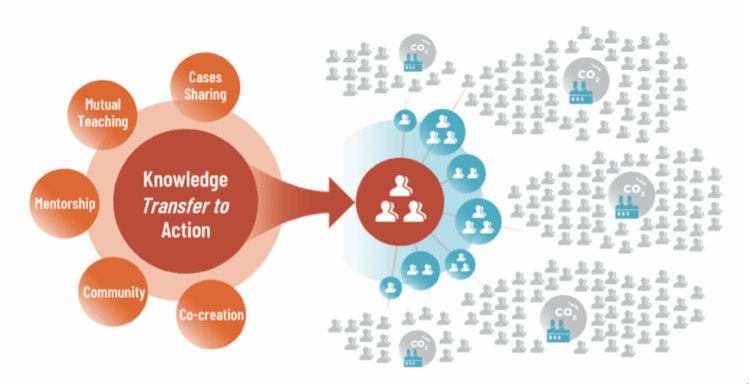
SSCA enables knowledge to travel faster. It creates an ongoing network where companies, suppliers, experts, and practitioners learn from one another and work together on real-time implementation challenges. The approach draws on the ECHO Model, a proven method of spreading specialized expertise through collaborative learning. Its principle is simple: All Teach, All Learn.
Participants bring actual challenges from their own organizations. Experts contribute specialized knowledge. Peers share what they have tried, what worked, and what did not. Together, they develop solutions that participants can take back and apply within their businesses. The program aims to help proven solutions move more quickly across supply chains and turn learning into action.
SSCA Knowledge Sharing Model
The SSCA’s knowledge-sharing model brings experts together to learn, plan, and act.
SSCA provides three connected levels of engagement designed to move participants from awareness to learning to action to scale practical and cost-effective solutions:
1 Climate Leadership Podcast Series
A public platform that makes practical supply chain insights, emerging trends, and corporate case studies related to supply chain decarbonization accessible to a broader audience.
Live Industry Conversations: Interactive discussions with business leaders and practitioners about emerging trends, real challenges, and lessons from implementation.
On- Demand Learning: Episodes distributed across multiple platforms, making practical insights and case studies accessible beyond live events.
Community Exchange: Online community interaction to help participants stay informed about industry developments and emerging practices.
2 Climate Fellowship Program
A free, invitation-only peer learning network for corporate climate practitioners working through real supply chain challenges.
Fellow Roundtables: Roundtable discussions on real-world climate challenges, with fellows sharing practical experience.
All Teach, All Learn through the ECHO Model: Case-based peer learning that draws on fellows’ knowledge and experience to co-develop practical solutions.
Supply Chain Best Practice Tour: Participants visit companies and facilities to see proven approaches in practice and learn directly from those implementing them.
3 Decarbonization Action Lab
Customized support for companies ready to address a specific supply chain decarbonization challenge.
Intensive Workshops: Focused working sessions that move teams from identifying a problem to evaluating practical solutions.
Cross-sector Solution Co-creation: Collaboration with cross-sector mentors, industry experts, and frontline practitioners to develop targeted solutions for specific business challenges.
SSCH by the Numbers
70 Hours
Project Learning
Through peer networking, case sharing, and project co-creation. Participants have also explored over 40 real-world decarbonization cases
70+ People
From 33 Companies
Engaged in SSCH—including 6 major automotive brands and 12 key suppliers.
7 Concepts
Decarbonization projects
Co-created with project partners and participants
Testimonials
“This SSCH co-creation camp is like a martial arts assembly. People come from different
industries and schools, and everyone has unique skills. Some people are veterans and
some have been in this field for a shorter time. I feel like I have
gained 10 years of experience. Through co-creation, we have an integrated team, real problems,
innovative solutions, and supportive mentors.”
– Wang Haisong, Ph.D., Director of Dual Carbon Business Products at Shanghai Electric Digital Technology
“”The SSCH co-creation cohort helped me see how we can work with customers and suppliers to create value across the value chain. I also valued the opportunity to share my experience in green finance and learn from others””
– Jin Diyi, Sustainability Manager at Suzano
Why This Model Matters
SSCA is built around a simple premise: the climate solutions companies need do not always need to be invented from scratch. Often, they need to be shared more effectively. By connecting companies and suppliers around real implementation challenges, SSCA can help reduce duplication, spread proven approaches, and strengthen the ability of suppliers to act. As the network grows, every participant brings new experience into the system, creating a growing body of practical knowledge that others can use. One company’s solution can become another company’s starting point
Join the Network
SSCA welcomes companies, suppliers, financial institutions, technical experts, and climate practitioners committed to moving supply chain climate action from ambition to implementation.
What We Do
By collaborating with partners, SSCH promotes a cohort-based carbon reduction learning community that focuses on the transformation of knowledge into action. Each cohort lasts for an average of three months, combining online and in-person learning.
Establish
sustainable supply chain learning communities
Shift
from a one-way model to an interactive, supportive community network