Europe’s Climate Ambitions Begin Beyond Its Borders
August 6, 2026 | By Pan Tao, Ph.D.
 " class="img-fluid" alt="Europe’s Climate Ambitions Begin Beyond Its Borders">
August 6, 2026 | By Pan Tao, Ph.D.
" class="img-fluid" alt="Europe’s Climate Ambitions Begin Beyond Its Borders">
Europe’s push toward climate neutrality is reshaping how global supply chains operate, from factory floors in China to corporate boardrooms across Europe.
The question is no longer whether to decarbonize. It’s how to do so in a way that works for business, workers, and the global economy.
To stay on track, the European Union has proposed cutting greenhouse gas emissions by around 90% by 2040 compared with 1990 levels, one of the most ambitious climate targets in the world.
Meanwhile, policies such as the Corporate Sustainability Reporting Directive (CSRD) and the Carbon Border Adjustment Mechanism (CBAM) are extending climate accountability far beyond Europe’s borders and deep into global supply chains.
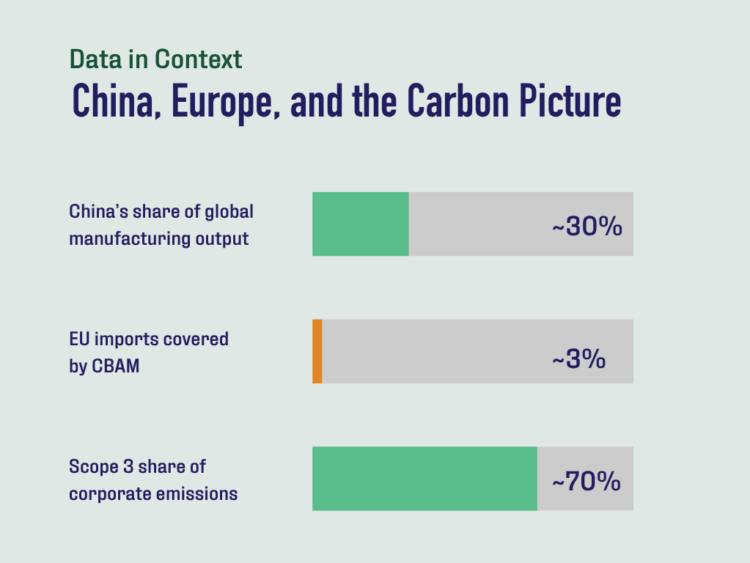
Under CSRD, thousands of companies will be required to report not only their own emissions but those across their value chains (Scope 3 emissions), often the largest share of their footprint (roughly 70%).
At the same time, CBAM is moving from a transitional reporting phase toward full implementation in 2026, when importers will begin paying for the carbon embedded in high-emissions products. These goods make up only around 3% of EU imports, about €80–90 billion annually, but account for a disproportionately large share of industrial emissions. The effectiveness of this policy will ultimately depend on whether it rewards cleaner production rather than merely increasing tariffs across supply chains and shifting the burden onto European businesses and consumers.
These policies send a clear signal: carbon now has a cost, no matter where production happens. They also raise a critical question: who bears the cost?
In recent months, several European leaders have openly reflected on whether parts of the EU’s regulatory framework have become overly complex or burdensome for businesses, particularly at a time of intensifying global industrial competition.
Across industries, climate policy is increasingly intersecting with global trade and corporate procurement decisions. Today, nearly two-thirds of the world’s largest companies have adopted net-zero targets, meaning that decarbonization requirements are rapidly spreading across global value chains.
However, decarbonization is not free, and some industries are already confronting its economic reality.
The aviation industry provides a clear example. The use of sustainable aviation fuel (SAF) is increasingly driven by regulatory requirements, yet SAF remains significantly more expensive than conventional jet fuel.
Current estimates suggest that reducing one ton of carbon emissions through SAF may require around €300 in additional cost compared with conventional aviation fuel.
To help address this gap, some companies are beginning to experiment with ways to share that cost. For example, logistics giant DHL offers customers the option to pay a premium for lower-carbon shipping through its GoGreen Plus program. It’s a simple idea with important implications: decarbonization costs don’t have to sit with one actor; they can be distributed across the value chain. Nevertheless, aviation is a sector where regulatory pressure is increasing. In many other industries, emissions reductions remain largely driven by voluntary corporate commitments, where comparable mechanisms for financing supply chain decarbonization are far less developed.
At the same time, the scale of investment needed is enormous. According to the International Energy Agency, achieving global net-zero emissions will require around $4–5 trillion in annual clean-energy investment by 2030, with much of it tied to industrial production and supply chains.
This brings us back to the core challenge:
How do we fund the transition fairly and effectively?
To answer that question, we have to look at where global production actually happens.
Manufacturing supply chains support hundreds of millions of jobs, particularly in emerging economies where production is concentrated. Yet many suppliers, especially small and medium-sized enterprises (SMEs), operate with narrow profit margins and have limited experience with carbon accounting, emissions reporting, or low-carbon technologies. If transition costs are simply pushed downstream, the burden could fall on firms with the least financial capacity to respond.
China sits at the center of this challenge, but also at the center of opportunity. China now accounts for roughly 30% of global manufacturing output and exported more than $3.7 trillion in goods in 2025, making it the world’s largest merchandise exporter. At the same time, China emits more than 12 billion tons of CO₂ annually, making it by far the world’s largest emitter. Conservative estimates suggest that at least 249 million tons of CO₂ are embedded in industrial goods exported from China to Europe, linking European consumption directly to the carbon footprint of China’s industrial system.
If those emissions were instead produced within the European Union and subject to a carbon price of around €100 per ton, they would translate into at least €30 billion in annual carbon costs.
This comparison highlights an important economic reality:
Supporting decarbonization in major manufacturing hubs like China isn’t just a global climate priority. It is directly linked to Europe’s own economic and climate interests.
The good news is that solutions are already emerging, and they offer a glimpse of what a more collaborative model could look like.
Some multinational companies are working directly with suppliers to reduce emissions through shared investments, technical support, and coordinated purchasing strategies.
For example, Apple’s Supplier Clean Energy Program encourages manufacturers to switch to renewable electricity in production. According to the company, more than 300 suppliers have joined the initiative, representing over 16 gigawatts of renewable energy commitments across its global supply chain.
European companies are also exploring similar approaches. IKEA has used aggregated procurement models to lower the cost of renewable electricity and energy-efficient technologies for suppliers. Decathlon, meanwhile, is supporting manufacturers in improving energy efficiency and adopting lower-carbon materials across its network.
ISC is doing this work on the ground in China as well, where the stakes are the highest. Through the Sustainable Supply Chain Hub (SSCH), ISC convenes sustainability managers from major brands, including Bayer, Sony, and SAIC Motor, alongside selected suppliers in cohort-based programs focused on real-world practice, such as building carbon data systems, implementing energy-efficiency measures, and adopting renewable solutions. The goal isn’t just knowledge sharing. It’s about equipping brands to lead supplier capacity-building directly within their own value chains so SMEs aren’t just told to decarbonize, but guided through it by their direct customers.
These initiatives remain voluntary corporate actions, but they demonstrate something important:
When costs and capabilities are shared, progress becomes possible.
If these models are already working, the next step is scaling them.
Public policy has a critical role to play, not by replacing private-sector action, but by reinforcing it.
This starts with aligning incentives. European policies like CBAM can do more than penalize high-carbon imports; they can reward cleaner production. If lower-emissions goods face lower costs or gain market advantages, it creates a business case for investment across supply chains.
It also requires trust. For supply-chain decarbonization to work across borders, emissions data must be credible and comparable. Continued progress in carbon accounting, transparency, and standards, particularly in major manufacturing economies like China, will be essential.
Finally, it requires cooperation. Mechanisms like Article 6 of the Paris Agreement offer pathways to recognize emissions reductions across borders and mobilize investment where it can have the greatest impact.
Decarbonizing global supply chains is not just a technical challenge; it is an economic one.
If the transition is designed to shift costs onto the most vulnerable parts of the system, it risks slowing progress and deepening inequality. But if it’s built on shared responsibility and practical collaboration, it can unlock faster, more durable change.
It’s what ISC sees every day through SSCH: brands and suppliers in China working through the hard practical questions together, building systems and trust that make decarbonization a scalable reality.
Global supply chains connect economies. They can also connect climate ambition with real-world results: emissions reductions, aligning efficiency with fairness, preserving hundreds of millions of jobs, and reshaping the economics of the transition by lowering the global cost of achieving carbon neutrality.
The task ahead is to make sure they do.
Working on supply chain decarbonization? Learn more about the Sustainable Supply Chain Hub and get in touch.
The views expressed in this article are those of the author and do not necessarily reflect the views of the Institute for Sustainable Communities (ISC).

Shanghai, China
Pan Tao, Ph.D, is ISC’s China Program Director, leading work on resilient communities, sustainable supply chains, and just transition policy. With 20+ years of experience in climate and environmental planning, he connects local action with national impact. He has held roles with the Clinton Climate Initiative and GTZ’s Eco-City Program, and led ISC’s U.S.-China Partnership for Climate Action. Pan holds a Ph.D. from Nanjing University and founded Shanghai’s first community garden, Ecoland Club Farm.